Why Tall Athletes Lose More Time Changing Direction Than Sprinting
Quick Answer: Changing direction requires decelerating your own mass and rotating it, and both costs rise with height. A taller athlete has a higher centre of mass, more rotational inertia and longer levers to control, so each cut costs more time and more force than it does for a shorter athlete. The trainable answers are eccentric strength, lower approach positions and better anticipation — not simply moving faster.
You are quick over thirty metres. Genuinely quick.
And in a game full of five-metre changes of direction, shorter players keep arriving before you.
That is not effort. It is physics, and some of it is trainable.

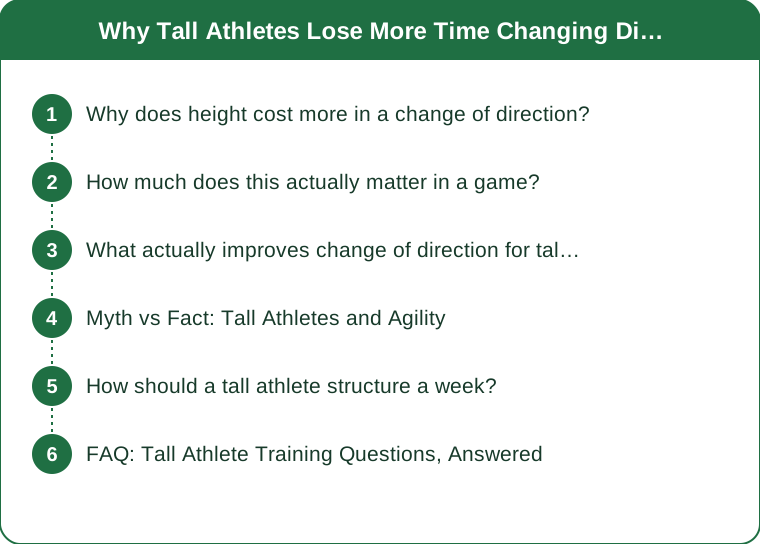
Why does height cost more in a change of direction?
Three separate mechanical penalties that arrive together.
Higher centre of mass. To turn sharply you must move your centre of mass over your new base of support. A higher centre of mass means it has further to travel and generates a larger toppling moment, so you need more force and more time to control it.
Greater rotational inertia. Rotational inertia scales with mass distributed away from the axis of rotation. Longer limbs and a longer trunk mean more resistance to being rotated, so initiating and stopping a turn both take longer.
Longer levers to decelerate. The braking force in a cut goes through a longer shin and thigh, which means higher joint moments at the knee and hip for the same deceleration.
None of this shows up in a straight-line sprint, where long levers are an advantage — a longer stride at the same cadence covers more ground. That is precisely why the profile of a tall athlete is often excellent top speed with a slower first three steps and slower cuts.
How much does this actually matter in a game?
It depends almost entirely on the distances your sport uses.
Most field and court sports involve a great many short efforts and very few long ones. In a typical netball, basketball or football context, a large majority of accelerations are over less than five metres, with a change of direction at each end.
That means the aspect of speed a tall athlete is naturally best at — top-end speed over 20 metres and beyond — is the aspect the sport asks for least often. Meanwhile the thing it asks for constantly is the thing that costs a tall athlete most.
The useful conclusion is not discouraging. It is that a tall athlete’s training should be weighted differently from a shorter teammate’s, and that the largest available gains are in deceleration and first-step mechanics rather than in top speed, which is likely already good.
What actually improves change of direction for tall athletes?
Braking capacity first, then position, then anticipation.
Eccentric strength is the primary lever. You cannot change direction faster than you can stop. Exercises that build braking capacity — slow eccentric split squats, Nordic hamstring curls, controlled depth drops — give more return here than any amount of ladder work. Two sessions a week, three sets of five to eight, with a genuine emphasis on the lowering phase.
Learn to get lower earlier. The single most common technical fault is arriving at a cut too upright. Lowering the centre of mass in the two steps before the change, rather than at the moment of it, dramatically reduces the toppling moment you have to fight. This is a coaching cue, not a strength quality, and it is available immediately.
Shorten the last steps. Taking one or two shorter, faster steps into a planned cut lets you reposition your base under a moving centre of mass. Tall athletes often carry long strides all the way into the turn, which is exactly what makes it slow.
Train anticipation deliberately. Reactive agility work with a visual cue — a coach pointing, a light, a partner’s movement — trains you to begin the deceleration earlier. Half a step of anticipation is worth more than any amount of extra leg strength, and it is the area where experienced tall athletes routinely outperform quicker but less aware opponents.

Myth vs Fact: Tall Athletes and Agility
Myth: Tall athletes are just less agile and that is that. Fact: Change of direction is heavily trainable, particularly the braking component. The mechanical penalty is real but it is a starting point, not a ceiling.
Myth: Ladder drills build agility. Fact: Ladders build foot speed in a pre-planned pattern with no braking demand. They are a fine warm-up and they transfer poorly to reactive change of direction. Deceleration work and reactive drills transfer far better.
Myth: You should train the same programme as your teammates. Fact: Your leverage profile is genuinely different. A tall athlete usually needs proportionally more eccentric and unilateral work and less top-speed work than a shorter teammate who is already quick off the mark.
Myth: Losing weight will fix it. Fact: Rotational inertia is about distribution, not just mass. Relative strength matters, but a tall athlete who loses the strength to brake has made the problem worse, not better.
Myth: Height is a disadvantage in sport generally. Fact: It is a trade. Longer levers cost you in cuts and cost you in the first three steps, and pay you in top speed, reach, stride length and leverage in contact. The job is to build the game around the trade, not to pretend it does not exist.
How should a tall athlete structure a week?
Weight the programme toward what your body finds hard, and keep what it finds easy on maintenance.
Two sessions a week of eccentric and unilateral strength. Split squats, single-leg RDLs, Nordics, controlled step-downs. This is the foundation, and it is also the primary injury-reduction work for the knee and hamstring, which are the joints under most load in a tall athlete’s cut.
One session of reactive agility. Short distances, real cues, genuine deceleration. Five metres out, cut, five metres back is a more relevant drill than anything over twenty metres.
One short session of top-speed work. You need it, but you likely need less of it than your teammates, and it is the quality you already have.
Ongoing: mobility at the ankle and hip. Getting low quickly requires ankle dorsiflexion in particular, and restricted ankles force you to stay upright into a cut. A tall athlete with stiff ankles has two of the three penalties compounding.
Give a block like this eight to twelve weeks before evaluating. Braking capacity is a strength quality and it adapts on a strength timeline.
This is general information, not medical advice. Change of direction training is demanding on knees and hamstrings — build volume gradually and see a qualified professional for any persistent joint pain.
FAQ: Tall Athlete Training Questions, Answered
Is a longer warm-up genuinely necessary?
Yes, and for a mechanical reason: longer muscles and tendons take longer to reach working temperature, and the joint moments in a cut are higher. Ten to fifteen minutes with progressive change-of-direction work included is a reasonable minimum.
Should I train differently in the off-season?
The off-season is the right time for the eccentric strength block, because it is fatiguing and it interferes with match performance if run at full volume in season. In season, drop to one maintenance session a week.
Why do I feel slower than I test?
Because most speed testing is a straight line, and most sports are not. If your 20 metre time is good and your game feels slow, you have confirmed exactly the profile described here — and you now know which quality to train.
TL;DR:
- Height costs you in changes of direction through a higher centre of mass, more rotational inertia and longer braking levers.
- Most field and court sport happens under five metres, which is where the penalty lands hardest and top speed helps least.
- The biggest gains come from eccentric braking strength, getting low two steps early, and shortening the final steps into a cut.
- Weight your week toward eccentric and reactive work, keep top speed on maintenance, and protect ankle mobility.
The long levers are not the problem. Arriving at the turn standing tall and travelling fast is the problem, and that part is entirely coachable.
Keep Reading
This article is for general informational and styling purposes only. Fit, sizing, and product availability may vary.
