The Cycling Frame Size Mistake Tall Athletes Keep Making
Quick Answer: Standard bike size charts are built around average proportions, so tall riders (especially those with long torsos relative to leg length) often end up on a frame that’s technically ‘their size’ by height but wrong by reach and stack — leading to knee strain and back pain.
You bought the size the chart told you to, and something still feels off every ride. That’s not a fit failure on your part — it’s the chart’s blind spot.

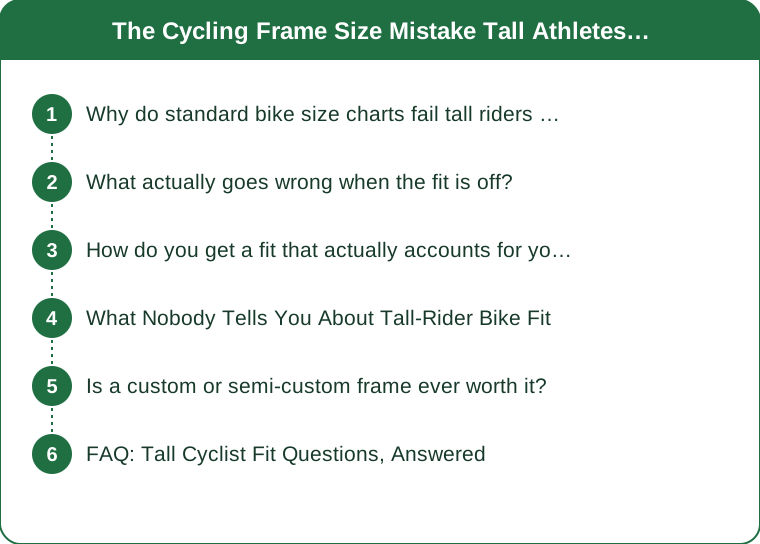
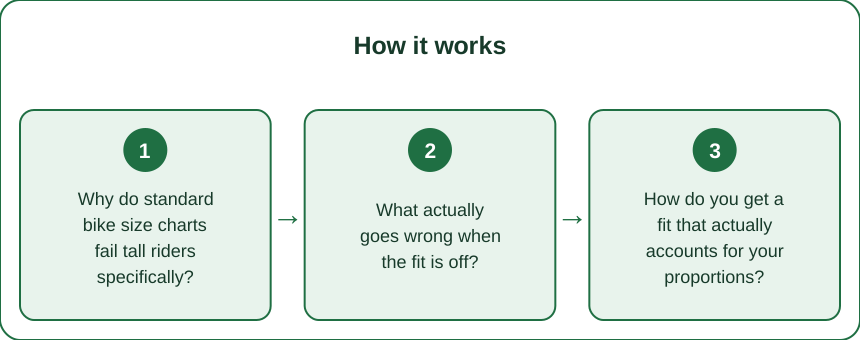
Why do standard bike size charts fail tall riders specifically?
Most sizing charts assume a fixed ratio between height, inseam, and torso length that holds up reasonably well up to about 5’8”-5’9”, then starts breaking down. Past that point, individual proportion variation (long torso vs long legs, arm length) matters more than height alone, but most in-store fittings still default to the height chart first.
The result is a frame that’s the ‘right’ size on paper but has a reach and stack height calibrated for someone with different proportions than yours, even at the same overall height.
What actually goes wrong when the fit is off?
The two most common issues are knee strain from incorrect saddle height relative to reach, and lower back pain from overreaching to the handlebars on a frame that’s proportionally too short in the top tube for your torso length. Both feel like fitness or flexibility problems, but they’re almost always fit problems in disguise.
A saddle pushed too far back or forward to compensate for the wrong frame size also throws off your pedal stroke angle, which is often what causes the knee pain specifically — not the frame size number itself, but the compensations riders make around it.
How do you get a fit that actually accounts for your proportions?
A professional bike fitting that measures torso length, arm reach, and inseam separately (not just standover height) is the single most reliable fix, and many bike shops offer this as a standalone service even if you didn’t buy the bike there. It typically costs $100-200 but prevents both discomfort and long-term joint strain from riding in a bad position for hundreds of hours a year.
If a professional fitting isn’t accessible, prioritizing stack and reach measurements over the marketed frame size when comparing bikes gets you most of the way there — these numbers describe actual geometry rather than a size label.

What Nobody Tells You About Tall-Rider Bike Fit
Most guides don’t mention that a slightly larger frame with a shorter stem often fits a long-torso tall rider better than a smaller frame with a longer stem, even though the smaller frame looks more ‘correct’ at a glance in the shop.
They also skip that seatpost setback matters as much as saddle height — a tall rider with proportionally shorter legs relative to torso often needs a different setback than the stock post provides, and this adjustment is nearly free compared to a full frame swap.
And almost nobody mentions that women’s-specific tall frames exist but are rarely stocked in-store, so online ordering with accurate measurements often beats settling for whatever’s on the floor.
Is a custom or semi-custom frame ever worth it?
For serious or frequent riders (training multiple times a week), a semi-custom geometry — where a standard frame is adjusted with a different stem, seatpost, or handlebar width — usually solves 90% of tall-specific fit issues without the cost of a fully custom frame. Full custom builds are typically only worth it for competitive racing or genuinely unusual proportions that off-the-shelf adjustments can’t fix.
For casual or fitness riders, a proper professional fitting on a well-chosen stock frame is almost always enough.
FAQ: Tall Cyclist Fit Questions, Answered
How do I know if my current bike is actually the wrong fit?
Persistent knee pain on the front or back of the joint, lower back tightness after rides, or feeling like you’re constantly reaching for the handlebars are the clearest signs worth getting checked.
Is buying the largest frame size always the right move for tall riders?
No — going up a size can overcorrect reach in the wrong direction if your torso-to-leg ratio doesn’t match the assumption baked into that larger frame either.
Does this apply to indoor spin bikes too?
Yes, though indoor bikes usually have more adjustability built in, so it’s more about dialing in seat and handlebar position correctly than frame size.
TL;DR:
- Standard bike charts assume proportions that stop matching many tall riders past 5’8”-5’9”
- Knee and back pain from riding are often fit issues, not fitness issues
- A professional fitting measuring torso, reach, and inseam separately beats going by height alone
- Stem length and seatpost setback are cheap fixes before considering a frame swap
The frame size on the chart was never wrong for an average rider — it just was never built with your proportions in mind, and a proper fit changes more than most tall athletes expect.
Keep Reading
This article is for general informational and styling purposes only. Fit, sizing, and product availability may vary.
