Why Landing Mechanics Matter More If You Are Tall
Quick Answer: Taller athletes have a higher center of mass, longer levers, and more body mass to decelerate, so landing forces are larger and the margin for error is smaller. The fix is not jumping less — it is landing deliberately: hips back and down, knees tracking over the toes, quiet feet, and a landing volume that builds gradually. Most tall-athlete knee complaints in jumping sports trace to deceleration mechanics, not to jumping itself.
You do the same drill as everyone else in the session and your knees are the ones that talk to you afterward.
That is not fragility, and it is not a training age problem. Landing is a deceleration task, and deceleration scales with mass and drop height — both of which are working against you. The third section covers the specific compensation tall athletes fall into without noticing.

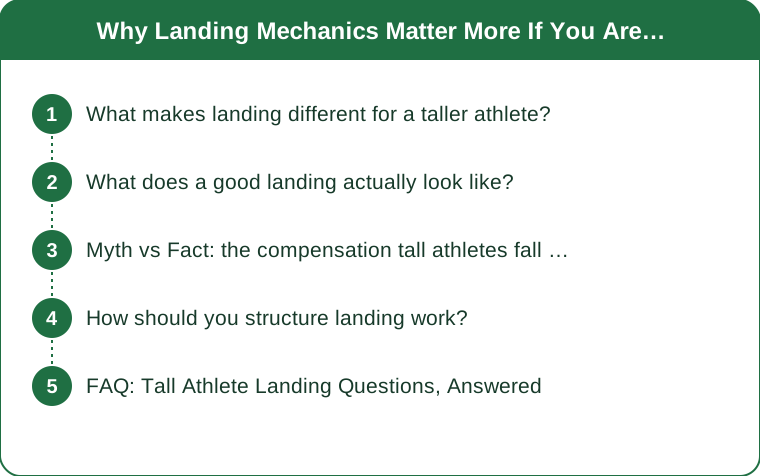
What makes landing different for a taller athlete?
Four factors, and they compound rather than adding.
More mass to decelerate. Landing force is a function of how much mass is moving, how fast it is moving, and how quickly you stop it. A taller athlete typically carries more total mass, which means more energy to absorb on every single landing.
A higher center of mass. Your center of mass sits further from the ground, which makes balance recovery harder and gives any deviation from a good position more time to develop into a real problem before you can correct it.
Longer levers. A longer femur and tibia mean larger moment arms at the knee. The same misalignment — a knee drifting inward, a foot rotating — produces a larger torque at the joint than it would for a shorter athlete. Length amplifies error.
Greater joint range to control. Longer limbs travel further through the same movement, so there is more distance over which mechanics can drift and more eccentric work required from the muscles doing the controlling.
None of this makes a tall athlete worse at jumping — many of these same properties are advantages in producing force and covering ground. They specifically make the landing half of the equation more demanding, and that is the half that generic programming under-coaches for everyone and dangerously under-coaches for tall athletes.
What does a good landing actually look like?
Coachable, checkable positions rather than vague advice to land softly.
Hips back and down first. The hip should initiate the absorption, not the knee. If your knees travel forward while your hips stay put, your quads and knee joint are absorbing what your glutes and hamstrings should be sharing. Cue: sit into it, do not squat down onto it.
Knees tracking over the second toe. The classic failure is the knee collapsing inward. For a tall athlete with long levers, this is the single most costly error because the torque it creates is proportionally larger.
Land on the whole foot, with a mid-to-forefoot bias, then let the heel come down. Landing flat-footed transmits force straight up the chain. Landing on the toes and staying there overloads the calf and Achilles.
Quiet feet. This is the best single cue in the whole category, and it works because it is self-correcting. A loud landing means force absorbed abruptly. Simply telling an athlete to land silently produces better mechanics without any of the technical explanation above.
Chest up, spine neutral. Folding at the waist on landing shifts load and reduces your ability to use the hips.
A landing depth that matches the drop. Bigger jumps need more range to absorb through. Landing stiff-legged from height is where impact goes straight into the joints.
Test yourself: film a set of five landings from the front and from the side. Watch for knees drifting in, hips staying high, and whether you can hold the landing position still for a beat. The stick-and-hold is the real test — if you cannot hold it, you did not control it.

Myth vs Fact: the compensation tall athletes fall into
Myth: If landings bother your knees, you should jump lower and less.
Fact: Reducing height while keeping the same mechanics just delays the problem, and the specific thing tall athletes do instead is worse.
Here is the compensation. Tall athletes with long limbs often find deep landing positions awkward — there is a lot of limb to organize, and it feels slow. So they instinctively land stiffer and shallower, cutting the range they absorb through.
That feels more athletic. It is the exact opposite of what the physics wants. Absorption over a shorter distance means higher peak force, and higher peak force with long levers is precisely the combination that irritates knees and Achilles tendons.
The second compensation is asymmetry. Most athletes have a preferred takeoff and landing leg. With longer levers, a modest side-to-side difference produces a larger difference in joint loading, so the tall athlete’s dominant-side knee accumulates disproportionate work. Single-leg landing drills expose this immediately — most people are surprised by how different the two sides feel.
The productive response is not less jumping. It is:
Add range. Deliberately land deeper than feels natural for a few weeks so absorption happens over more distance.
Train the eccentric strength to control that range. Slow tempo squats, Romanian deadlifts, and step-downs build the ability to decelerate. You cannot land well into a range you are not strong in.
Progress landing volume like any other load. Landings are reps. A session with a hundred landings is a hundred reps of maximal eccentric work, and it should be built up over weeks the way you would build up any other training stress.
How should you structure landing work?
A practical progression, and the intent is that this sits alongside your sport rather than replacing anything.
Phase 1 — position, no height. Squat jumps landing to a held position. Drop squats. Focus entirely on the stick-and-hold. Two sets of five, a few times a week. Boring, and it is where the pattern gets built.
Phase 2 — low box drops. Step off a low box, land, hold for two seconds. Not jumping down — stepping off, so the drop height is controlled. Build height slowly over weeks.
Phase 3 — single leg. Same progression, one leg at a time. This is where asymmetries show and where the real protective strength gets built, because most sport landings happen on one leg.
Phase 4 — reactive. Only once the above are solid. Repeated hops, bounds, depth jumps. Quality over quantity — stop the set the moment landings get loud. Noise is the fatigue signal.
Strength underneath all of it: heavy hip hinge work, split squats, and calf work. Tall athletes especially benefit from calf and Achilles capacity work, because longer levers put more demand on the ankle.
Watch total volume across your week. If your sport already involves a lot of jumping, added plyometrics is added load on the same tissue, not separate work. Count it.
Persistent knee pain, pain that changes how you walk, or swelling is a see-a-professional situation rather than something to train through. This is general information, not medical advice.
FAQ: Tall Athlete Landing Questions, Answered
Do taller athletes really get more knee injuries?
Height alone is not destiny, and plenty of tall athletes have long healthy careers. What is well established is that landing mechanics are a major modifiable factor in knee injury risk, and that the biomechanical consequences of poor mechanics scale with limb length and mass. That makes mechanics work higher-value for a tall athlete, not a sign of inevitability.
Should I avoid depth jumps entirely?
No, but earn them. Depth jumps are the highest-intensity landing exercise there is, and they belong at the end of a progression rather than at the start. Build the positions and the eccentric strength first.
Why do my knees hurt more on hard courts than on grass?
Surface stiffness affects how much of the impact your body has to absorb rather than the ground. Harder surfaces return more force to you, and that amplifies whatever your mechanics are already doing. It is a reason to be more careful about volume on hard surfaces, not a reason to avoid them.
TL;DR:
- More mass, a higher center of mass, and longer levers all increase landing demand for tall athletes.
- Long levers amplify small alignment errors into large joint torques.
- The common compensation — landing stiff and shallow — raises peak force rather than lowering it.
- Cue hips back, knees over toes, and quiet feet; the stick-and-hold is the real test.
- Build eccentric strength, progress landing volume like any other load, and count sport jumping toward the total.
The frustrating thing about being tall in a jumping sport is that the same physics that lets you get to the rim also charges you more on the way down, and almost no programming acknowledges the second half. The good news is that landing is a skill, it responds fast to deliberate practice, and quiet feet is a cue you can apply in every single session starting today. Fix the deceleration and the jumping takes care of itself.
Keep Reading
This article is for general informational and styling purposes only. Fit, sizing, and product availability may vary.