The Shin Guard Gap Almost Every Tall Athlete Deals With (And How to Actually Close It)
Quick Answer: Most shin guard sizing charts are based on height alone, but shin length doesn’t scale evenly with height — sizing up one size and checking the guard reaches within an inch of the ankle bone closes the gap that height-only charts miss.
You bought the size the chart recommended for your height. It still stops a good two inches above your ankle, leaving exactly the spot that takes the most contact unprotected.

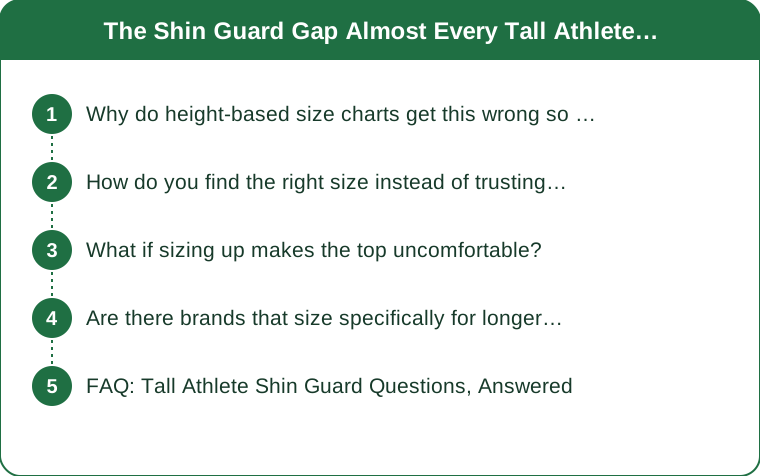
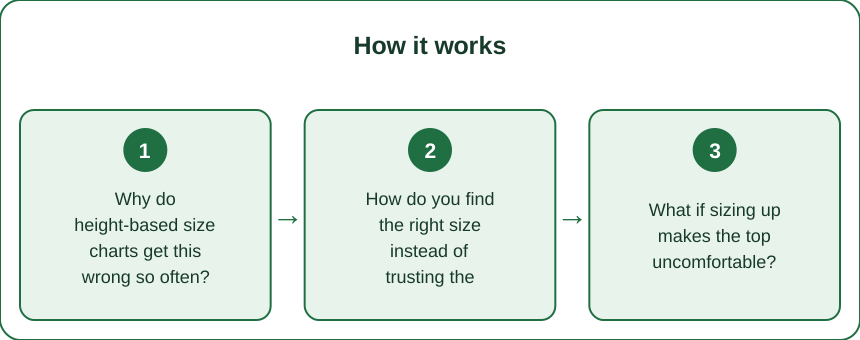
Why do height-based size charts get this wrong so often?
Shin guard charts assume a fixed ratio between height and shin length, but that ratio varies more than most brands account for — especially for tall athletes whose leg length is often proportionally longer than the chart’s baseline assumption.
The result is a guard that technically matches your height bracket but falls short in actual coverage.
How do you find the right size instead of trusting the chart?
Measure from just below your kneecap to about an inch above your ankle bone — that’s your target coverage length. Compare that number directly to the guard’s listed length, not the height range on the packaging.
When in doubt between two sizes, size up. Extra length can be adjusted with strap tightness; a guard that’s too short cannot be extended.

What if sizing up makes the top uncomfortable?
A longer guard sometimes sits closer to the knee joint than expected, which can feel restrictive during deep knee bends. Look for a slight curve or hinge at the top edge — guards designed with athlete movement in mind flex there instead of digging in.
This tradeoff (slightly less knee mobility for full ankle coverage) is usually worth it, since ankle-area impacts are more common than knee-adjacent ones in most sports.
Are there brands that size specifically for longer shins?
Some running and field-sport specific lines now offer tall or extended-length options separate from standard sizing, though availability is inconsistent across sports. Checking a brand’s size chart for actual length-in-inches (not just S/M/L by height) is the more reliable filter regardless of brand.
FAQ: Tall Athlete Shin Guard Questions, Answered
How much of a gap above the ankle is actually risky?
Anything more than an inch of exposed shin above the guard leaves the lower shin, a common impact zone, unprotected.
Should tall athletes always size up from the height chart?
As a starting point, yes — verify with an actual measurement rather than assuming, since shin length varies even among similarly tall athletes.
Do compression sleeves under the guard help with the gap?
They add comfort and slight impact absorption but don’t substitute for correct guard length — treat them as a supplement, not a fix.
TL;DR:
- Height-based size charts don’t account for shin length variance, especially for tall athletes
- Measure from below the kneecap to above the ankle bone and match that to the guard’s listed length
- Size up rather than trust the height bracket alone
- A curved top edge helps offset the mobility tradeoff of a longer guard
The gap isn’t a flaw in your gear routine — it’s a gap in how the chart was built. Measuring directly closes it.
Keep Reading
This article is for general informational and styling purposes only. Fit, sizing, and product availability may vary.
