Why Standard Training Programs Underperform for Tall Athletes
Quick Answer: Longer limbs mean a longer range of motion, a longer moment arm, and more total work per rep at the same load. Tall athletes generally do better with slightly reduced ranges on some lifts, wider or adjusted stances, more emphasis on positional strength, and higher relative volume tolerance in some movements and lower in others. The standard program isn’t wrong; it was calibrated for average leverage.
You’re doing the same program as everyone else, at a lower relative load, and it feels harder. That’s not a strength deficit — it’s geometry.

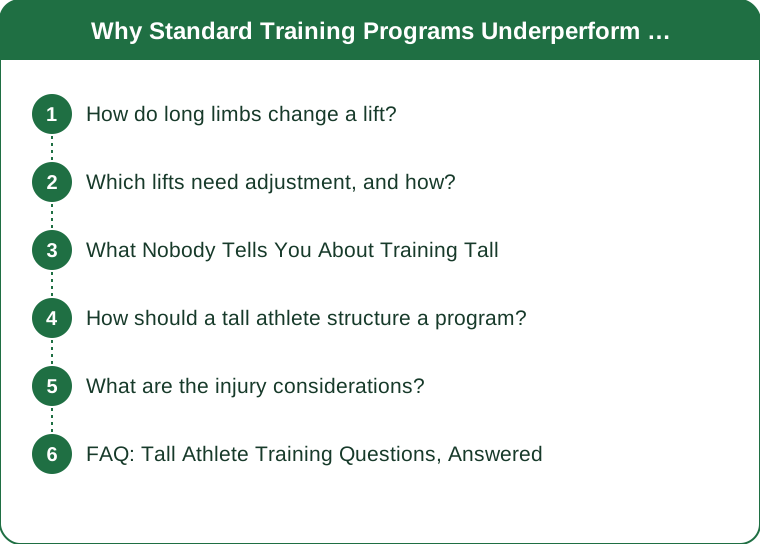
How do long limbs change a lift?
Three ways, and they compound rather than cancel.
Longer range of motion. A squat with long femurs travels further than the same squat with short ones. Same weight, more distance, more total work. A tall lifter doing five reps is doing meaningfully more mechanical work than a short lifter doing five reps at the same load.
Longer moment arms. Torque equals force times distance from the joint. Longer limbs put the load further from the working joints, which means more torque for the same weight. This is why long-armed lifters often find bench pressing disproportionately hard and deadlifting relatively easier — arm length hurts in one and helps in the other.
Different positional demands. Long femurs relative to torso length force a more forward torso lean in the squat to keep the bar over midfoot. That’s not a technique error — it’s the only mechanically valid position for that build, and coaching it away creates problems.
The practical consequence: relative loads look lower on some lifts for tall athletes, and that’s expected rather than a deficiency. The comparison that matters is against your own previous numbers.
Which lifts need adjustment, and how?
Specific and worth knowing.
Squat: expect and allow a more forward torso angle with long femurs. A slightly wider stance with feet turned out reduces the required forward lean. Heeled lifting shoes help substantially — they let the knee travel forward, which lets the torso stay more upright. High-bar may be uncomfortable; many long-femur lifters do better with low-bar or with a front squat variation.
Deadlift: generally a favorable lift for long arms, since a longer reach means a shorter bar path. Conventional often works well. Long-torso, short-arm builds may prefer sumo.
Bench press: the hardest lift for long arms — longer range, longer moment arm. A slightly wider grip reduces the range. Arching within a comfortable range reduces it further. Expect a lower bench relative to your other lifts, permanently.
Overhead press: long arms mean a long overhead range. Expect slower progress and don’t compare to shorter lifters.
Rows and pull-ups: generally favorable, with long arms providing reach.
Lunges and split squats: longer stride requirements. Use a taller rear-foot elevation than the standard 12 inches for Bulgarian split squats — proportional to leg length, not a fixed number.
The pattern: adjust the position to the leverage, don’t force the leverage into a standard position.
What Nobody Tells You About Training Tall
Equipment is calibrated for average. Standard bench height, standard rack pin spacing, standard machine seat range, standard cable pulley height. Machines in particular frequently don’t adjust far enough, and using one that doesn’t fit is worse than skipping it.
Warm-up needs more time. More joint range means more tissue to prepare, and long-limbed athletes commonly report needing a longer warm-up before positions feel available.
Volume tolerance differs by lift. Because each rep is more work, the same set-and-rep scheme is a higher absolute workload. Reducing total sets on the highest-range lifts while keeping intensity is often more productive than following the program’s volume exactly.
Mobility requirements are higher for the same positions. Getting into a deep squat with long femurs demands more ankle dorsiflexion and hip flexion than the same position with short femurs. Ankle mobility work has an outsized return for tall lifters.
Bar path matters more. Longer levers mean small deviations from the ideal path create larger torque errors. Technique consistency is worth more, not less.
Progress looks slower on paper. Adding 5kg to a lift with a 20 percent longer range is a larger increase in total work than the same 5kg for a shorter lifter. The numbers understate the progress.

How should a tall athlete structure a program?
Same principles, adjusted parameters.
Prioritize positional strength. Time spent in the hard positions — paused squats, pause bench, deficit work only where appropriate — pays off more when leverage is unfavorable, because control through a long range is the limiting factor.
Consider reduced-range variations where they serve the goal. Box squats to a set depth, floor press, rack pulls. Not as permanent replacements, but as ways to load a lift where full range is disproportionately punishing.
Bias volume toward favorable lifts. If deadlifts and rows suit your leverage, use them as primary drivers. Fighting your build on the bench press for years is a strategy with poor returns.
Add dedicated ankle and hip mobility. 10 minutes, most sessions. This is a higher priority for long-limbed athletes than for average ones.
Unilateral work is disproportionately valuable. Longer limbs create larger left-right asymmetries in reach and load distribution, and unilateral work exposes and addresses them.
Set up your own equipment positions and record them. Seat heights, pin heights, bench positions — write them down, because the default is never right and re-finding them each session wastes time and introduces inconsistency.
What are the injury considerations?
A few patterns are more common with longer limbs, and they’re mostly manageable.
Lower back in the squat and deadlift. The forward torso angle that long femurs require increases spinal loading. This is manageable with technique, appropriate loading, and strong bracing, but it means back position discipline matters more.
Shoulders in pressing. Long arms with a wide range at the bottom of a bench press put the shoulder in a vulnerable position. Limiting the depth slightly, using a moderately wider grip, and keeping the elbows from flaring all reduce it.
Knees in deep positions. Long femurs with limited ankle mobility force compensation, which frequently shows up at the knee. Ankle mobility work is the fix, not avoiding depth.
Hamstrings. Longer muscle-tendon units under stretch, particularly in sprinting and dynamic movement. Consistent eccentric hamstring work is well supported for injury prevention generally, and more relevant here.
None of this means tall athletes are fragile. It means the standard technique cues and standard equipment positions were built around a different geometry, and the adjustments are worth making deliberately rather than discovering by injury.
This is general information, not medical advice. Work with a qualified coach for technique, and consult a professional about pain or existing injury.
FAQ: Tall Athlete Training Questions, Answered
Should I squat as deep as everyone else?
Depth should be determined by where you can maintain a neutral spine and controlled position, not by a universal standard. Many long-femur lifters have a shallower usable depth, and forcing more depth by allowing the pelvis to tuck under is a worse trade than stopping higher.
Why is my bench press so much weaker than my deadlift?
Leverage. Long arms lengthen the bench press range and shorten the deadlift range relative to average. A large gap between the two is expected for tall lifters and isn’t a sign of an imbalance that needs correcting.
Do I need longer rest periods?
Often yes, on the highest-range compound lifts, because each set represents more total work. If the program says 90 seconds and you need 150, take 150 — the quality of the next set matters more than adherence to the printed rest.
TL;DR:
- Long limbs mean longer range, longer moment arms, and more work per rep at the same load.
- Adjust position to your leverage — wider squat stance, heeled shoes, wider bench grip — rather than forcing standard technique.
- Bias volume toward lifts your build favors; expect a permanently lower bench relative to deadlift.
- Ankle and hip mobility have an outsized return; write down your equipment settings.
A program written for average leverage will always feel harder at a lower load. That’s geometry, not a strength problem — and adjusting the parameters is the fix.
Keep Reading
This article is for general informational and styling purposes only. Fit, sizing, and product availability may vary.
