Why Tall Athletes Fatigue First in Agility Drills, Not Endurance
Quick Answer: Change-of-direction work penalizes height because a taller athlete has a higher center of mass and longer limbs, which means more angular momentum to arrest and re-create with every cut. Endurance running rewards the same levers. Train deceleration and shorter prep steps rather than more conditioning.
You finished the mile near the front. Twelve minutes later, on the five-cone drill, you were bent over while shorter teammates were still crisp on rep six.
That is not a conditioning gap. It is a mechanics tax, and it has a specific address.

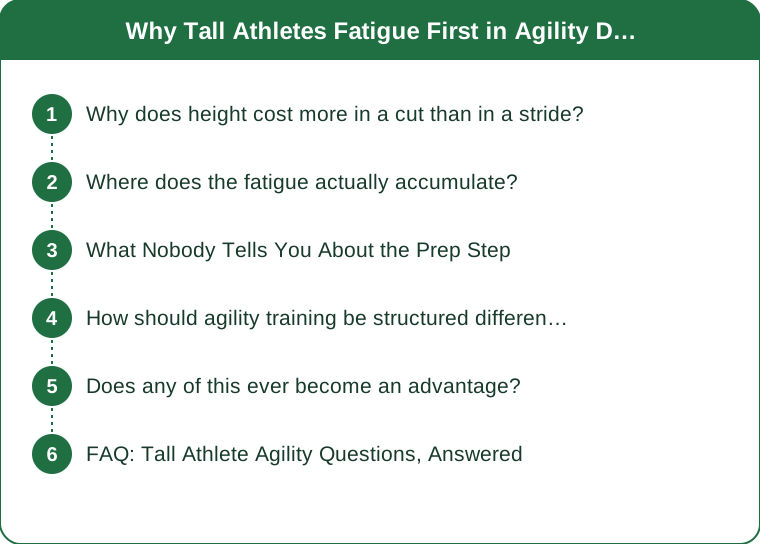
Why does height cost more in a cut than in a stride?
Two related pieces of physics do most of it.
First, center of mass height. A taller athlete’s center of mass sits higher off the ground, which means every direction change requires tipping and re-stabilizing a taller inverted pendulum. The higher the mass sits, the more torque is needed to redirect it and the longer the correction takes.
Second, rotational inertia. Longer limbs have more moment of inertia — resistance to changes in rotational speed. Swinging a longer leg through takes more force to start and more force to stop. In a straight-line run, that is a fair trade because you also cover more ground per stride. In a drill where you reverse direction every 1.5 seconds, you pay the cost repeatedly and never collect the benefit.
The result: at the same relative fitness, a taller athlete does measurably more mechanical work per change of direction. Repeated 20 times in a drill, that gap becomes visible as fatigue.
Where does the fatigue actually accumulate?
Not in your lungs. Ask a tall athlete what is burning after agility work and the answer is almost always quads, hips, and lower back, not chest.
That points at eccentric deceleration. The braking step before a cut requires the quadriceps and glutes to absorb force eccentrically — lengthening under load. Eccentric work causes more muscle damage per unit of effort than concentric work and fatigues faster.
A taller athlete arriving at a cone at the same speed carries more momentum to absorb and does it over a longer lever. That braking demand is the real bottleneck.
There is a trunk cost too. Stabilizing a longer torso against rotation during rapid direction change loads the obliques and lower back continuously. The lower-back tightness many tall athletes report after agility sessions is a stabilization symptom, not a spine problem.
What Nobody Tells You About the Prep Step
Coaches cue tall athletes to get lower. Useful, but incomplete — and often applied at the wrong moment.
What actually separates efficient tall athletes from inefficient ones is stride frequency in the two steps before the cut. A long-legged athlete who approaches a cone at natural stride length arrives with one big, committed step and has to brake with everything at once.
The fix is to chop the last two steps — shorter, faster, lower — so the deceleration is spread across two contacts instead of one. Shorter athletes do this instinctively because their natural stride already is short. Taller athletes have to be taught it, and almost nobody teaches it explicitly.
The second unmentioned thing: tall athletes often decelerate too late because their approach speed feels controllable right up until it is not. Starting the braking sequence one step earlier feels absurdly conservative and reliably produces faster drill times, because you spend less time recovering from an overshoot.
Record one drill from the side. Count your steps in the final three yards. If it is two, that is your whole problem.

How should agility training be structured differently?
Adjust volume, rest, and emphasis rather than trying to out-condition the physics.
Train deceleration as its own skill. Two sessions a week, 6 to 8 reps of a 10-yard build-up into a controlled 3-step stop, full rest between. This is strength-speed work, not conditioning — treat it that way.
Build eccentric strength directly. Slow-tempo split squats with a 3 to 4 second lowering phase, Nordic hamstring curls, and lateral step-downs. Eccentric capacity is the tank agility drills are drawing from.
Extend rest intervals in drills. If a drill is prescribed at 20 seconds work with 20 seconds rest, take 40. The goal of agility work is quality of movement, and a tall athlete reaches degraded mechanics sooner. Practicing sloppy cuts teaches sloppy cuts.
Add ankle and foot work. Higher center of mass means more demand on the smallest stabilizers. Calf raises through full range, single-leg balance with eyes closed for 30 seconds, and pogo hops build the base that everything above depends on.
Do agility before conditioning, always. Fatigued cutting is how knees get hurt, and taller athletes reach that state earlier in the session.
Does any of this ever become an advantage?
Yes — in every phase of the game that is not a tight cut.
Once a taller athlete is moving in a straight line, longer strides mean higher top speed potential and lower stride frequency at any given pace. Over 30 yards and beyond, the advantage flips decisively.
Reach is its own category: interception radius, blocking, contesting, rebounding, and defensive coverage all scale with wingspan and standing reach in ways no amount of agility compensates for.
And the same rotational inertia that makes quick cuts expensive makes momentum harder to disrupt once established. Tall athletes are difficult to move off a line.
The strategic reading is straightforward: train the cut so it is not a liability, and build your game around positions and situations where straight-line speed and reach decide outcomes. Chasing parity with a shorter teammate in a five-yard shuttle is optimizing the one drill you were never going to win.
FAQ: Tall Athlete Agility Questions, Answered
Will losing weight fix this?
Only marginally, and only if you have weight to lose. The variable is where your mass sits and how long your levers are, not how much you weigh. Strength-to-weight ratio helps everything, but it does not change the geometry.
Are ladder drills useful for tall athletes?
Somewhat, for foot speed and rhythm, but they are the least specific option because they involve almost no deceleration. Prioritize drills with real braking and real direction change — the ladder is a warm-up, not the work.
How long before deceleration training shows up in drills?
Eccentric strength adaptations begin within 3 to 4 weeks, and the technical piece — shorter prep steps — can improve within a couple of sessions once you are consciously counting steps.
Should I train barefoot or in minimal shoes for ankle strength?
For accessory work on a safe surface, it is a reasonable addition. For actual cutting drills, wear the shoes your sport requires — lateral support matters more when the load is high.
TL;DR:
- Height raises center of mass and lengthens levers, so every direction change costs more mechanical work.
- Fatigue shows up in quads, hips, and lower back — it is eccentric braking, not cardio.
- Chop the final two steps before a cut and start decelerating a step earlier than feels natural.
- Train eccentric strength, take longer rests in drills, and do agility before conditioning.
You are not out of shape and you are not uncoordinated. You are paying a physics bill that shorter athletes do not receive. Train the braking side of the equation, and the drill that used to expose you turns into one you merely find inconvenient.
Keep Reading
This article is for general informational and styling purposes only. Fit, sizing, and product availability may vary.
