Why Tall Athletes Lose More Ground in the First Ten Metres
Quick Answer: Longer limbs are longer levers, which means more rotational inertia and more time to complete each stride cycle. Tall athletes therefore have a lower stride frequency ceiling and accelerate more slowly from a standstill — while reaching a higher top speed once upright. Train acceleration specifically with a more aggressive forward lean, shorter first steps and heavier strength work, and use your top-end speed where the race is actually decided.
First ten metres: last.
By forty: first.
The first ten is a lever problem, not a fitness one.

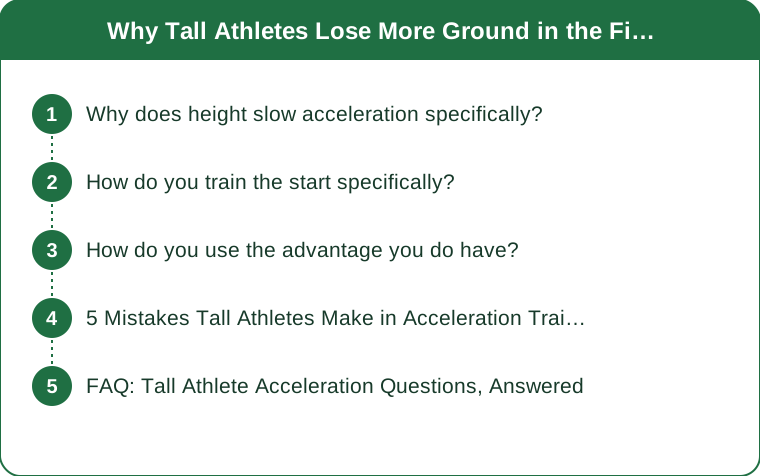
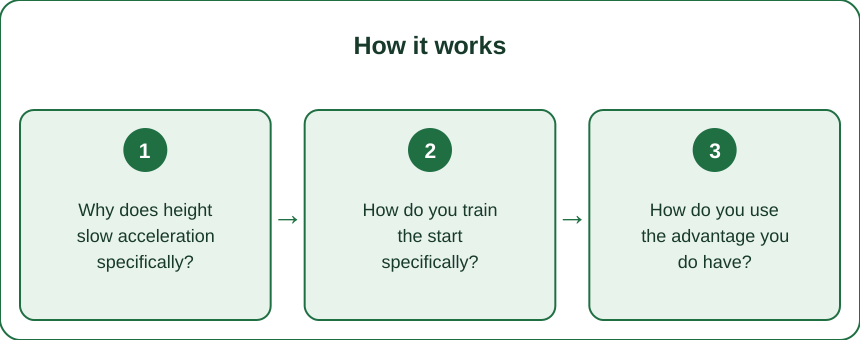
Why does height slow acceleration specifically?
Because acceleration depends on how quickly you can cycle your legs, and long legs cycle more slowly.
Rotational inertia scales steeply with limb length. The resistance of a limb to angular acceleration rises sharply as it gets longer — roughly with the square of the length for a given mass distribution. A longer leg is genuinely harder to swing quickly, and no amount of strength changes the geometry.
Stride frequency has a physical ceiling. Acceleration comes from applying force frequently. Taller athletes typically hit a lower maximum stride frequency, which caps how fast they can accelerate in the first few steps.
Getting into position takes longer. The acceleration phase requires a low body angle. A taller athlete has further to travel from a low start position to upright, so the acceleration phase is physically longer in both distance and time.
Centre of mass sits higher. A higher centre of mass makes the forward-lean position harder to hold, and forward lean is what directs force horizontally rather than vertically.
But the same levers pay off later. Longer legs cover more ground per stride. Once upright and at frequency, stride length dominates, and taller athletes commonly reach higher top speeds than shorter ones. The trade is real in both directions.
Which is why the pattern is so consistent: slower to ten metres, faster from thirty. Elite sprinting has plenty of tall athletes, and almost all of them are relatively weak starters who win in the second half of the race.
How do you train the start specifically?
Six adjustments, and the first is a technique change rather than a fitness one.
Take deliberately shorter first steps. The instinct for a tall athlete is to reach, which puts the foot ahead of the centre of mass and brakes. The first three steps should feel almost too short, with the foot landing under or behind the hips.
Hold the forward lean longer. Aim for a body angle around 45 degrees at the start, rising gradually over the first 8 to 10 strides rather than popping upright in three. Taller athletes need more distance to rise, and rising early is the most common fault.
Drive the arms hard and short. Arm frequency and leg frequency are coupled. Short, aggressive arm actions raise the achievable step rate at the point where frequency is the limiting factor.
Do wall drills for position. Lean into a wall at roughly 45 degrees and perform 3 sets of 10 second marching, then single-leg drives. It builds the specific position, which is more limiting than the strength.
Train heavy for horizontal force. Heavy sled pushes, hip thrusts and Bulgarian split squats develop the horizontal force production the start demands. 3 to 4 sets of 5 to 8 reps at genuinely heavy loads, twice a week.
Practise short sprints, not just long ones. 10 to 20 metre repeats with full recovery train exactly the phase you are weak in. Most tall athletes train the phase they are already good at, because it feels better.
Seasonal note: as the weather cools into autumn, acceleration work needs a longer warm-up than top-speed work. Cold hamstrings and hip flexors in a deep start position is a common autumn injury pattern — add 10 minutes before any sprint start work below about 15C.

How do you use the advantage you do have?
Six tactical points that turn the same physics into a benefit.
Choose distances where top speed decides the outcome. Over 100m and beyond, top speed matters far more than the start. Over 20m, it barely matters at all. Where you can choose, choose the longer version.
In team sports, use your second gear. Football, rugby, netball and hockey are full of 20 to 40 metre runs where a tall athlete pulls away. Positioning yourself so you receive the ball with running room ahead is worth more than trying to win the first two steps.
Anticipate earlier. A half-second earlier read compensates completely for a slower start. Tall athletes who read the play well are rarely beaten off the mark in practice.
Use your reach. In court and field sports, an extra arm’s length changes what is contestable. It is a genuine and often underused advantage in interceptions and challenges.
Do not train to be a shorter athlete. Chasing a start you are physically unsuited to at the expense of the top-end speed you are built for is a poor trade. Bring the start up to competent and take the top end to excellent.
Fix the kit that undermines the mechanics. This sounds trivial and is not. Leggings that ride up mid-stride, shorts that ride, or a top that shifts every time you drive the arms all cost focus and rhythm. Look for tall-specific inseams and long-torso cuts rather than sizing up, which just adds width where you do not need it and still ends short.
5 Mistakes Tall Athletes Make in Acceleration Training
Mistake one: over-striding out of the blocks. Reaching for the ground with a long leg puts the foot in front of the centre of mass and applies a braking force on every one of the first steps. It feels powerful and it is the biggest single error.
Mistake two: standing up too early. Popping upright in three steps ends the acceleration phase prematurely. Tall athletes need more strides to rise, not fewer.
Mistake three: training only long sprints. Doing what you are good at feels better and improves nothing about the deficit. 10 to 20 metre repeats are the specific medicine.
Mistake four: light, high-rep leg work. The start is a heavy-force event. Endurance-style leg training builds the wrong quality. Go heavy on hip thrusts, split squats and sled pushes.
Mistake five: comparing yourself to shorter athletes over the wrong distance. Losing the first ten metres to a shorter training partner is expected physics. Comparing over forty metres is the honest test.
And the bonus one: neglecting hip flexor and hamstring mobility. A longer lever needs more range to cycle cleanly, and tight hips shorten the effective stride at exactly the point where you are trying to raise frequency.
FAQ: Tall Athlete Acceleration Questions, Answered
Why do shorter athletes beat me off the line?
Longer limbs have more rotational inertia, so your maximum stride frequency is lower. It is geometry, not fitness.
Will I ever have a fast start?
You can make it good, not exceptional. Better technique and heavy horizontal strength work close a lot of the gap, and your top speed is where you win.
How short should my first steps be?
Shorter than instinct suggests — the foot should land under or behind your hips for the first three steps.
How long should I stay leaning forward?
Rise gradually over 8 to 10 strides from around a 45 degree body angle. Standing up in three is the common fault.
What strength work helps most?
Heavy sled pushes, hip thrusts and Bulgarian split squats, 3-4 sets of 5-8 reps at genuinely heavy loads, twice weekly.
Do tall athletes have any sprint advantage?
Yes — a higher top speed from greater stride length. That is why the pattern is losing the first ten metres and winning the last forty.
Does kit really matter?
More than people admit. Leggings riding up mid-stride or a top shifting on every arm drive breaks rhythm. Look for tall-specific inseams, not a larger size.
TL;DR:
- Longer limbs mean more rotational inertia and a lower stride frequency ceiling — slower acceleration is physics.
- The same levers deliver a higher top speed, which is why you reel people in by forty metres.
- Take shorter first steps with the foot landing under the hips, and rise over 8-10 strides, not three.
- Train 10-20m repeats and heavy horizontal strength work twice a week.
- Play to your second gear in team sports, and fix kit that rides or shifts mid-stride.
At your next session, film your first three steps from the side. If your foot is landing ahead of your hips, that is the whole ten metres right there.
See It in Motion
Seen here: High Waist Yoga Leggings with Side Pockets — shop it on bubblelime.com
Keep Reading
This article is for general informational and styling purposes only. Fit, sizing, and product availability may vary.
