Why Tall Athletes Need a Longer Warm-Up Than Everyone Else
Quick Answer: A longer limb travels further and faster at the joint’s end range for the same movement, which means more tissue is loaded through a greater distance before you are ready. Standard warm-ups are timed and rep-counted for average limb length, so a taller athlete completes the same reps having covered less of their available range. The fix is more range, not more time necessarily. Add two sets of full-range dynamic work before the team warm-up.
The warm-up is not too short in minutes.
It is too short in distance travelled.

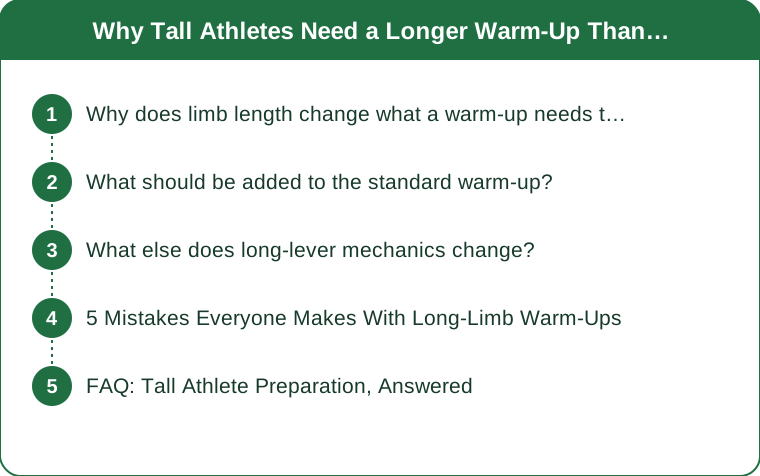
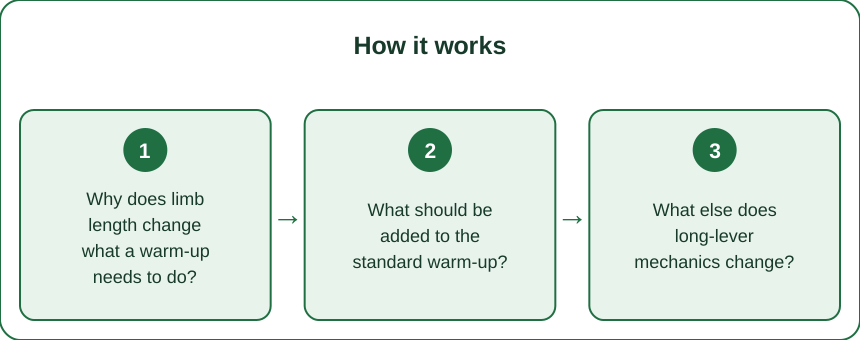
Why does limb length change what a warm-up needs to do?
Because range of motion is measured in degrees but tissue is loaded in distance.
A longer segment covers more distance for the same joint angle. Twenty degrees of hip flexion moves a long femur substantially further through space than a short one. The muscle and tendon lengthen more in absolute terms, and it is absolute change that the tissue experiences.
Standard warm-ups prescribe reps, not range. Ten leg swings prepares a joint through whatever range you happen to use. Taller athletes often use a smaller proportion of their available range in a group setting, because the tempo is set for everyone.
End range is where injuries happen. Hamstring strains in sprinting occur near full lengthening at high speed. If your warm-up never approached that length, it did not prepare the tissue that will be loaded.
Longer limbs also mean higher end-point velocities. The same joint rotation speed produces a faster-moving foot or hand at the end of a longer lever. Higher speed at greater length is exactly the risky combination.
And blood flow has further to travel. Circulatory warm-up to the extremities takes marginally longer in a longer limb, which shows up as hands and feet staying cold - a real signal, particularly on cool autumn mornings.
What should be added to the standard warm-up?
Four additions, taking about five minutes, done before the group session rather than instead of it.
Full-range dynamic leg swings, front-back and side-side. Slow and large first, then faster. The instruction is to reach your actual end range, not to match the person next to you. Ten each direction per leg.
Long-lever hip work specifically. Walking knee hugs into a lunge, and straight-leg kicks with a reach. The hamstring at length is the priority tissue for anyone with long legs doing anything fast.
Shoulder circles through full range if your sport uses the arms. Same principle - a long arm covers a lot of distance, and the end range needs specific preparation. Big slow circles, then controlled fast ones.
Progressive-speed runs, more of them. Where a shorter athlete may need three build-ups, a taller one benefits from five, each a little faster. The last one should be close to session pace.
Do it before the team warm-up, not after. Arriving five minutes early and doing your own range work means the group session then acts as a top-up rather than the entire preparation. This is the practical solution for anyone in a coached environment.
And extend it as the weather cools. Autumn mornings need noticeably more warm-up than August evenings did. The same routine that worked in summer is not enough in October, and the first cold weeks are when strains cluster.

What else does long-lever mechanics change?
Deceleration, change of direction, and the cost of a poor landing.
Stopping takes longer and costs more. A longer body carries more momentum and needs more distance to decelerate, which is why agility drills fatigue tall athletes faster than endurance work does. The braking, not the running, is the expensive part.
Landing loads travel through a longer chain. More joints between ground and centre of mass means more places for the load to be managed badly. Landing mechanics deserve specific practice rather than being assumed.
Change of direction needs a lower position. Taller athletes have to drop further to get into an effective cutting position, which requires more hip and ankle mobility. Ankle mobility is often the actual limiter and is rarely trained.
Which makes single-leg strength disproportionately valuable. Split squats, single-leg deadlifts, and step-downs build the control that a longer lever demands. Bilateral strength work does not transfer as well for this specific problem.
And recovery between agility efforts should be longer. The higher braking cost means more tissue damage per repetition. The same drill volume is a bigger dose for a taller athlete, which is worth saying out loud to a coach.
None of this is a disadvantage overall. Longer levers produce more speed and reach at the end point once prepared. The preparation is what needs to differ, not the ambition.
5 Mistakes Everyone Makes With Long-Limb Warm-Ups
Matching the tempo of the group instead of the range. Doing ten leg swings at everyone else’s amplitude means preparing a fraction of your available range. Go slower and larger, then catch up on speed.
Treating static stretching as a warm-up. Static holds before explosive work can temporarily reduce power output and do not prepare tissue for speed. Dynamic, progressive, and full-range is the format. Save static work for afterwards.
Skipping the ankles. Ankle mobility limits how low a tall athlete can get, which limits cutting, landing, and squatting. Two minutes of ankle work has an outsized effect and almost nobody does it.
Wearing kit that restricts the end range. Leggings that are too short pull at the ankle in a deep position and compression gear sized for an average torso restricts hip flexion. If your kit stops you reaching end range, it is a warm-up problem, not just a comfort one.
Not adjusting as the season cools. The August warm-up is inadequate in October, and the first cold snap is when hamstring strains appear. Add time and layers as the temperature drops, and keep the layers on until you start.
And the bonus mistake: assuming pain in a long limb is the same as pain in a short one. Persistent pain at a tendon insertion, particularly hamstring or Achilles, deserves proper assessment rather than more stretching. This is general information, not medical advice.
FAQ: Tall Athlete Preparation, Answered
How much longer should my warm-up actually be?
Five extra minutes of full-range dynamic work, done before the team session. The addition is range and build-up runs, not simply repeating the group warm-up for longer.
Do I need different strength training too?
More single-leg and control work, and more attention to ankle and hip mobility. The strength requirements are not different in kind, but the control demands of a longer lever are higher, and unilateral work addresses that directly.
Why do I get so much more tired in agility drills?
Because deceleration is more expensive with more mass and longer levers, and agility drills are mostly deceleration. Ask for slightly longer rest between reps rather than assuming you are less fit - your work per rep is genuinely higher.
TL;DR:
- Longer limbs cover more distance for the same joint angle, so rep-counted warm-ups under-prepare them.
- End range at speed is where strains happen - if the warm-up never got there, it did not prepare it.
- Add five minutes of full-range dynamic work before the team warm-up, plus extra build-up runs.
- Deceleration, not running, is the expensive part of agility work for a taller frame.
- Extend the warm-up as autumn cools - the summer routine is not enough in October.
Arrive five minutes early to your next session and do your own full-range leg swings first. That is the whole intervention.
Keep Reading
This article is for general informational and styling purposes only. Fit, sizing, and product availability may vary.
