Why Tall Athletes Need Different Rowing Machine Settings
Quick Answer: Tall rowers need three specific changes: a lower footplate setting (higher number on a Concept2, meaning the plate sits lower), a lower damper than instinct suggests (3 to 5, not 8 to 10), and a lower stroke rate with a longer drive. Long levers produce a longer stroke, which means more distance per stroke and less need for rate. The most common mistake is fighting a footplate that is too high, which restricts the catch and shortens the very advantage height provides.
Here is each setting and why it changes with height.

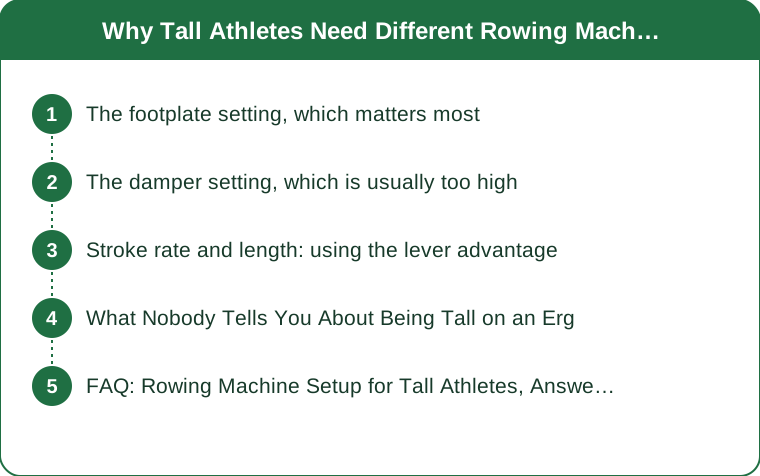
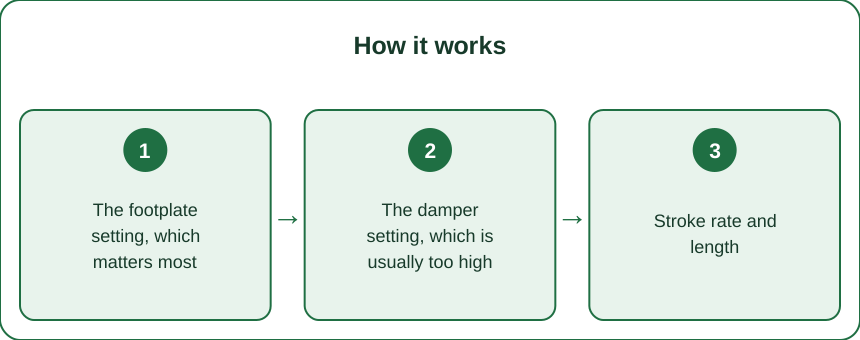
The footplate setting, which matters most
On a Concept2, higher numbers move the footplate lower, which is counterintuitive and catches almost everyone out. Taller rowers with longer shins generally need a higher number - typically 2 or 1 rather than the 3 or 4 many machines are left on.
The rule of thumb is that the strap should cross the widest part of the foot, roughly over the ball. Too high and the strap sits toward the toes, which lets the heel lift excessively at the catch.
Long shins are the specific issue. A tall rower compressing at the catch brings the shins to vertical or beyond if the plate is too high, which jams the position and forces the back to round.
The symptom is a catch that feels cramped and a lower back that works too hard. Most tall rowers assume this is a flexibility problem. It is frequently a settings problem, and it takes ten seconds to test.
Test it by sitting at the catch without pulling. Your shins should be at or just past vertical, with your heels lifting only slightly. If your heels are well off the plate or your back is rounding to get there, lower the plate.
Foot height also changes where the handle finishes. Too high a plate raises the finish position and makes the handle contact the ribs rather than the lower sternum, which is uncomfortable over long pieces.
The damper setting, which is usually too high
Damper is not resistance in the way people assume - it changes the drag factor, which is closer to gear ratio in cycling. A high damper is a heavy gear, and heavy gears are not automatically better.
Most competitive rowers train at damper 3 to 5, which corresponds to a drag factor around 110 to 130. Tall rowers often benefit from the lower end of that because a long stroke already moves a lot of water per pull.
A high damper shortens the effective stroke for tall rowers. The heavier load encourages a shorter, more forceful pull and rewards muscular strength over the length advantage that height provides.
It also loads the lower back more. Tall rowers already have longer levers and more torque at the hips; adding a heavy drag factor increases that load on every single stroke of a long piece.
Check drag factor rather than damper number. The number on the flywheel varies with how dirty the machine is - a dusty erg at damper 5 can be at damper 8 equivalent. The monitor menu shows actual drag factor.
Around 115 to 125 drag factor is a sensible starting point for most tall rowers doing steady-state work. Save higher settings for short, deliberate strength pieces, not for general training.

Stroke rate and length: using the lever advantage
A taller rower covers more distance per stroke, which is a genuine mechanical advantage. The correct response is to row at a lower rate, not to match everyone else’s.
If a shorter rower is at 24 strokes per minute, an equivalent effort for a tall rower might be 20 to 22. Trying to match rate means either shortening the stroke or working substantially harder for the same split.
Length comes from the sequence, not from reaching. The drive is legs, then body swing, then arms - and tall rowers gain most from a full leg drive before the back opens. Reaching further at the catch with the arms adds nothing and costs position.
The finish should be at the lower ribs, with the handle drawn to a consistent point. Longer arms mean a longer arm draw, which is part of where the extra distance per stroke comes from.
Recovery should be slower than the drive, at roughly a 1:2 ratio. Tall rowers often rush the recovery because the slide is longer and feels slow, which spikes the rate and wastes the advantage.
Watch the split, not the rate. A lower rate with the same or better split is unambiguously more efficient, and it is what the height is for.
And the chain should be level. A long-limbed rower more easily pulls up or down rather than horizontally, which wastes force. Filming from the side shows this immediately.
What Nobody Tells You About Being Tall on an Erg
Standard machines fit most tall rowers fine, but the slide length can be marginal above roughly 195 cm. Check that you are not running out of slide at the catch - some models offer extensions.
Handle height at the finish is a common irritation. Long arms mean the handle can catch on the ribs or the sports bra band. Adjusting the finish position slightly lower usually fixes it, as does a lower footplate.
Seat comfort matters more over long pieces. Longer bodies mean more weight and more time on the seat; a pad genuinely helps and is not a sign of weakness.
Your monitor numbers are not comparable to shorter athletes’. Longer levers move more water per stroke, so raw splits favour tall rowers while power-to-weight comparisons often do not. Compare against yourself.
Lower back load is the main injury consideration. Tall rowers have more torque at the hips on every stroke, which means technique errors compound faster. Rounding at the catch is the specific thing to avoid.
Hamstring and hip flexibility limits the catch more for tall rowers, simply because the range required is greater. Ten minutes of hamstring and hip work two or three times a week meaningfully improves the catch position.
Cooler autumn gyms change the warm-up requirement. Long limbs lose heat faster and take longer to warm through - five minutes of easy rowing before any real work matters more as the gym gets colder.
And persistent lower back pain during or after rowing is worth having assessed rather than adjusting settings indefinitely. This is general information, not medical advice.
FAQ: Rowing Machine Setup for Tall Athletes, Answered
What footplate setting should a tall person use?
Usually a higher number on a Concept2, which puts the plate lower - often 1 or 2 rather than the default 3 or 4. The strap should cross the widest part of the foot, and your shins should reach vertical at the catch without rounding your back.
Should tall rowers use a higher damper setting?
No - usually lower. Damper changes drag factor, not resistance in the way people assume. Most rowers train at 3 to 5, and tall rowers often want the lower end because a long stroke already moves plenty of air per pull.
What drag factor should I aim for?
Around 115 to 125 for general steady-state work. Check the monitor’s drag factor reading rather than trusting the damper number - a dusty flywheel changes the relationship substantially.
Why does my lower back hurt when I row?
Most often a catch position that rounds the back, frequently caused by a footplate that is too high for long shins. Tall rowers also carry more torque at the hips, so technique errors compound faster. Persistent pain needs proper assessment.
What stroke rate should a tall rower use?
Lower than a shorter rower at the same effort - perhaps 20 to 22 where they are at 24. You cover more distance per stroke, so matching someone else’s rate means either shortening your stroke or working harder.
Am I too tall for a standard rowing machine?
Most tall rowers fit fine. Above roughly 195 cm, check you are not running out of slide at the catch - some models offer slide extensions.
How do I know if my settings are right?
Watch your split at a given rate and effort rather than the numbers themselves. A lower rate producing the same or better split means the settings and the stroke are working with your height rather than against it.
TL;DR:
- Footplate lower, not higher. On a Concept2 that means a higher number - often 1 or 2. The strap should cross the widest part of the foot.
- Damper 3 to 5, not 8 to 10. Damper sets drag factor, not resistance, and a heavy setting shortens the stroke that height gives you.
- Check drag factor on the monitor (aim ~115 to 125) - a dusty flywheel makes the damper number meaningless.
- Lower stroke rate, longer stroke. 20 to 22 where a shorter rower is at 24, with the same or better split.
- Length comes from the leg drive sequence, not from reaching with the arms at the catch.
- Recovery slower than the drive, roughly 1:2. Rushing the longer slide spikes the rate and wastes the advantage.
- Watch for rounding at the catch - tall rowers carry more hip torque, so errors compound faster.
Hamstring and hip work two or three times weekly meaningfully improves the catch. Persistent lower back pain deserves proper assessment rather than endless setting changes - this is general information, not medical advice.
Keep Reading
This article is for general informational and styling purposes only. Fit, sizing, and product availability may vary.
