Why Tall Athletes Need Longer Warm-Ups: The Long Lever Problem
Quick Answer: Longer limbs mean longer levers: every joint moves through more absolute distance per rep, muscles work at longer lengths, and torque on hips, knees, and shoulders is higher for the same movement. Cold tissue tolerates all of that worst, which is why tall athletes so often feel stiff through the first sets and pick up niggles in warm-ups that felt fine to everyone else. The fix is not training less — it is warming up longer and more specifically: more general heat, full personal ranges rehearsed, and ramp sets that respect the extra distance.
Here is the mechanics, and a template that fits real schedules.

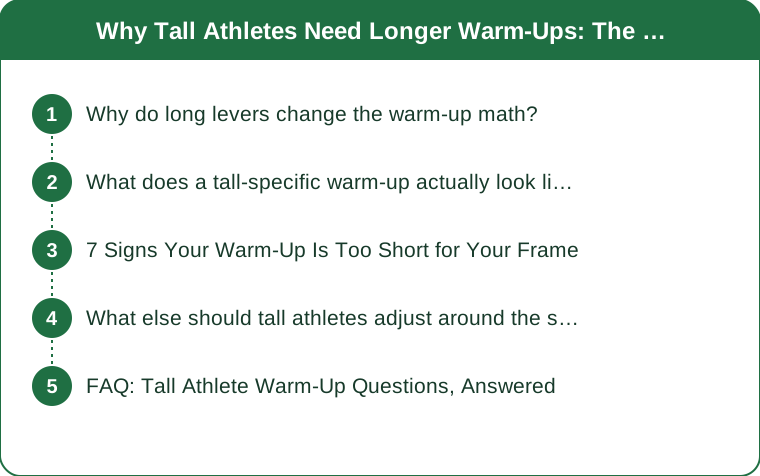
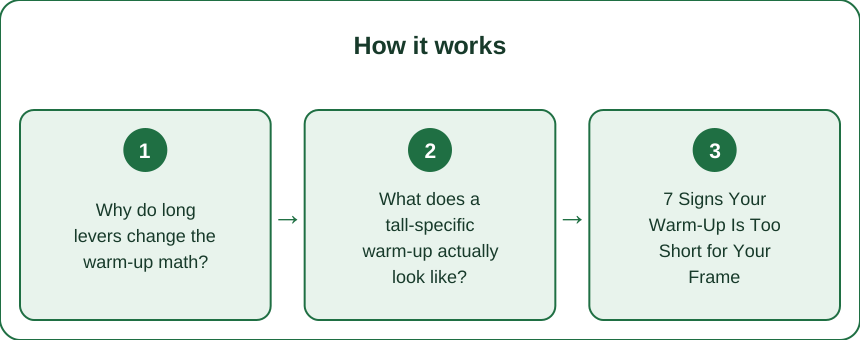
Why do long levers change the warm-up math?
Because distance, length, and torque all scale with limb length — and standard warm-ups assume standard limbs.
Every rep is a longer journey. A squat to the same relative depth moves a long-femured athlete’s hips through more absolute distance; an overhead press travels further; a stride covers more ground. More distance per rep at the same tempo means more mechanical work before the first working set even starts — done by tissue that is still cold.
Muscles operate at longer lengths. Long segments put hamstrings, adductors, and lats through bigger length changes in ordinary movements. Muscle tolerates loaded length beautifully when warm and poorly when cold — and the loaded-at-length position is precisely where tall athletes spend more of every exercise.
Torque is force times lever arm. The same dumbbell held in a longer arm produces more torque at the shoulder; the same body weight on a longer femur produces more knee and hip torque in a lunge. Tall athletes routinely handle higher joint loads at the same external weight as shorter training partners — invisible on the loading chart, very visible to the joints.
And the blood has further to travel. Warming up literally means raising muscle temperature via blood flow, and a longer body is simply more territory to perfuse. The five minutes that gets a five-foot-four teammate glowing leaves five-foot-eleven still cold at the extremities.
None of this is fragility. It is geometry — and geometry responds to preparation.
What does a tall-specific warm-up actually look like?
Twelve to fifteen minutes in three blocks, replacing the generic five.
Block one — general heat, five to seven minutes. Easy cardio you can feel in the legs and breath: bike, brisk incline walk, rower at conversation pace. The target is genuinely warm — light sweat starting, not just motion completed. Tall athletes should extend this block first whenever time is short elsewhere.
Block two — full personal ranges, four to five minutes. Move every joint the session will use through the range your limbs actually own, unloaded: deep bodyweight squats with a pause, walking lunges with a long stride, leg swings front and side, arm circles and wall slides for overhead days, hip openers before change-of-direction sport. The key instruction: your range, not the demo’s. The point is to visit the end positions warm before load visits them for you.
Block three — ramp sets with one extra step. Where a shorter athlete might take two warm-up sets to a working weight, take three, starting lighter. The extra set costs ninety seconds and buys the joints a graded rehearsal of the exact distances and torques coming. On sprint or court days, the equivalent is one extra build-up run and a few progressive strides before anything maximal.
Two placements matter as much as the content: warm up as close to the session start as possible — heat drains fast standing around — and rehearse the day’s specific first movement last, so the groove is fresh.
On cool late-summer mornings, the first genuinely crisp ones of the season, add a layer over everything and keep it on through block two. Long limbs cool fast in exactly the weather that is arriving.

7 Signs Your Warm-Up Is Too Short for Your Frame
1. The first working set feels like the heaviest of the day. If set one grinds and set three flows, the ramp was too short — the body finished warming up on the working weight.
2. Knees drift inward on early reps and settle later. Alignment that self-corrects as you warm is alignment that started cold. Long femurs show this earliest.
3. Hips pinch at depth in the first squats, then release. The end range was reached by load before it was visited unloaded. Block two exists for exactly this.
4. Hamstrings grab on the first fast stride. The classic tall-athlete warning shot. Long hamstrings under sudden length demand respect graded build-ups — and punish their absence.
5. Shoulders click or catch on the first overhead reps, then quiet down. Longer arms mean more torque overhead; the shoulder is asking for wall slides and a lighter first ramp set.
6. The second exercise always feels better than the first. If exercise two consistently outperforms exercise one regardless of order, exercise one is functioning as your warm-up. Give it a real one instead.
7. Next-day soreness concentrates near tendons and attachments rather than muscle bellies. Insertion-point soreness after ordinary sessions is a loading-while-cold signature — the tissue least served by a hurried start.
One of these occasionally is noise. Three of them weekly is your frame requesting a longer runway — and it is cheaper to grant it than to rehab the alternative.
What else should tall athletes adjust around the session?
Setup, kit, and the cool-down — the warm-up’s quieter siblings.
Set equipment for your levers before you touch weight. Rack pins a notch higher, seat rails back, bench spacing wider. Adjusting mid-set steals warmth and attention; a frame that fits from rep one lets the warm-up’s alignment survive into the work.
Dress for the longer runway. Cold ankles and calves stay cold in cropped gear that fits average-height athletes as full-length. Actual full-length coverage matters more the longer the leg: tall-inseam leggings — the 31-inch-plus range genuinely built for long legs — keep the tissue you just spent seven minutes heating warm through block three, and full-length yoga pants over shorts do the same job on court days. On the first cool mornings of the season, that coverage is the difference between block one lasting and block one leaking away.
Give the cool-down the mirror treatment. Long levers accumulate more total movement per session, and five minutes of easy movement plus unhurried breathing afterwards is the same geometry argument run in reverse. It is also when the day’s end-range work consolidates.
Track your own before-and-after for two weeks. Add the longer warm-up to half your sessions and note first-set quality, niggle frequency, and next-day soreness. Tall athletes are chronically under-served by average-body programming; your own log is the evidence that actually settles what your frame needs.
The extra seven minutes is not a tax on training time. For a long-levered body, it is where a meaningful share of the injury prevention and first-set performance actually lives.
FAQ: Tall Athlete Warm-Up Questions, Answered
How much longer should my warm-up be than my teammates?
As a rule of thumb: half again to double a generic five-minute routine — twelve to fifteen minutes covering general heat, full personal ranges, and one extra ramp set. Judge by outcome: the first working set should feel like the second one used to.
Does being tall really increase injury risk?
Height itself is not an injury sentence — but longer levers raise joint torque and put muscles at longer working lengths, and cold tissue handles both worst. Preparation is the variable you control, and it is the one this article is about.
Should I stretch statically before training?
Long holds before work are the wrong tool for the job — they calm tissue you are trying to activate. Save them for after. Before, use moving range work: deep unloaded reps, swings, strides, slides — visiting end ranges warm rather than parking in them cold.
I train in a cold gym. What changes?
Extend block one, keep a layer on through the ramp sets, and re-warm briefly after any long rest or coaching pause. Long limbs shed heat fast; in a cold room, staying warm is part of the program, not a comfort preference.
TL;DR:
- Longer limbs mean more distance per rep, muscles working at longer lengths, and higher joint torque at the same weight — and cold tissue handles all three worst.
- Replace the generic five minutes with twelve to fifteen: general heat until genuinely warm, every joint through your personal range unloaded, and one extra ramp set.
- First-set grinding, early knee drift, hamstring grabs, and insertion-point soreness are the signature signs the runway was too short.
- Fit the equipment before touching weight, keep long legs covered in real full-length gear as mornings cool, and mirror the warm-up with a five-minute cool-down.
Run the longer version for two weeks and let your first working set render the verdict. On a long-levered frame, it usually takes about three sessions to become non-negotiable.
See It in Motion
Seen here: High Waist Embossed Yoga Leggings with Side Pockets — shop it on bubblelime.com
Keep Reading
This article is for general informational and styling purposes only. Fit, sizing, and product availability may vary.
